Vegastories Storyboard-to-Screen Pipeline: Inside our 24-Hour Frame-by-Frame Cartoon Render Process
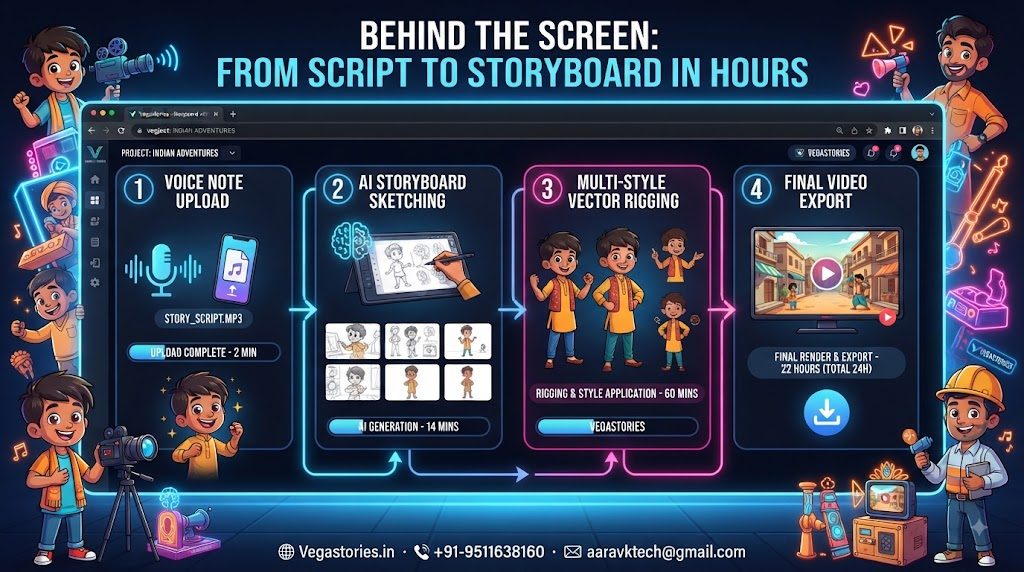
Inside the Vegastories Production Engine: How Script Ideas Turn into Animated Shorts in 24 Hours
Many business owners and content creators assume that producing custom animation requires massive budgets, dedicated production houses, and months of waiting. Traditional studio workflows involve endless revisions, expensive frame-by-frame sketching, and painstaking audio synchronization. But high-speed digital channels demand rapid content execution. At Vegastories, we rebuilt the production line from scratch to bring scalable, high-quality storytelling to Indian brands overnight.
Understanding the Modern Animation Bottleneck
Traditional cartoon production was designed for television broadcasts and feature films, where timelines extend over months. When a startup wants to communicate a new product feature or a local bakery wants to share a holiday story, waiting six weeks for a 30-second clip eliminates marketing momentum. The friction comes down to three main bottlenecks: manual storyboarding, visual style consistency, and audio lip-sync alignment.
Stage 1: From Voice Note to Dynamic Script Beats
The creative journey begins with raw input. Instead of demanding complex production briefs, our workflow accepts simple voice notes, rough text outlines, or conversational customer chats. Our narrative engine breaks down the audio input into distinct story beats, automatically highlighting emotional turning points, key brand messages, and dialogue cues.
Stage 2: Instant Style Selection and Character Rigging
Once the narrative structure is locked, the visual phase begins. A core principle of our platform is visual variety. To keep audiences engaged, campaigns must avoid repetitive templates. Our engine selects from a wide array of visual styles—such as 3D animated renders, traditional Indian comic illustrations, flat vector designs, or Chibi art—and pairs them with relatable Indian character archetypes like shopkeepers, college students, or tech founders.
Stage 3: Automated Audio Syncing and Expression Mapping
The most time-consuming part of classic animation is matching mouth movements to vocal cadences. Our audio engine parses natural cadence and regional accents across multiple Indian languages. It maps phonetic sounds directly onto vector character rigs, adding nuanced facial expressions like a subtle smile or wide-eyed surprise precisely where the narrative demands it.
Stage 4: Rendering social-ready formats
Finally, the scenes are composited with cinematic lighting, dynamic camera movements, and clear text overlay zones designed specifically for mobile screens. The platform outputs optimized vertical and horizontal formats ready for immediate publishing across Instagram, YouTube Shorts, and WhatsApp Business.
My Take on Speed Versus Quality
If you are choosing between traditional video production and rapid cartoon animation, consider your publishing frequency. Traditional video shoots often deliver polished results, but they are expensive and difficult to scale. For daily social media presence and high-engagement brand storytelling, a flexible, animated production pipeline provides unmatched speed and consistency without sacrificing creative control.
🌐 Vegastories.in · 📞 +91-9511638160 · 📧 aaravktech@gmail.com